To analyze fMRI data from multiple brains---including both their commonalities and differences---it is essential to establish functional correspondence across individuals. Hyperalignment Haxby et al., 2020 is a functional alignment method that establishes such correspondence, based on either brain responses to the same stimuli Haxby et al., 2011Guntupalli et al., 2016 or on functional connectivity profiles Guntupalli et al., 2018. The Individualized Neural Tuning (INT) model Feilong et al., 2023 builds upon hyperalignment to model individualized brain functional organization based on a shared template.
Procrustes hyperalignment
Procrustes hyperalignment Haxby et al., 2011 is based on the solution to the orthogonal Procrustes problem. It finds a high-dimensional rotation in the feature space to align the brain responses of different individuals into a common space while preserving the representational geometry.

Fig 1. Schematic illustration of Procrustes hyperalignment. With a high-dimensional rotation in the feature space (middle), the response patterns of different individuals (left) are aligned into a common space. The representational geometry (right) is preserved in this process.
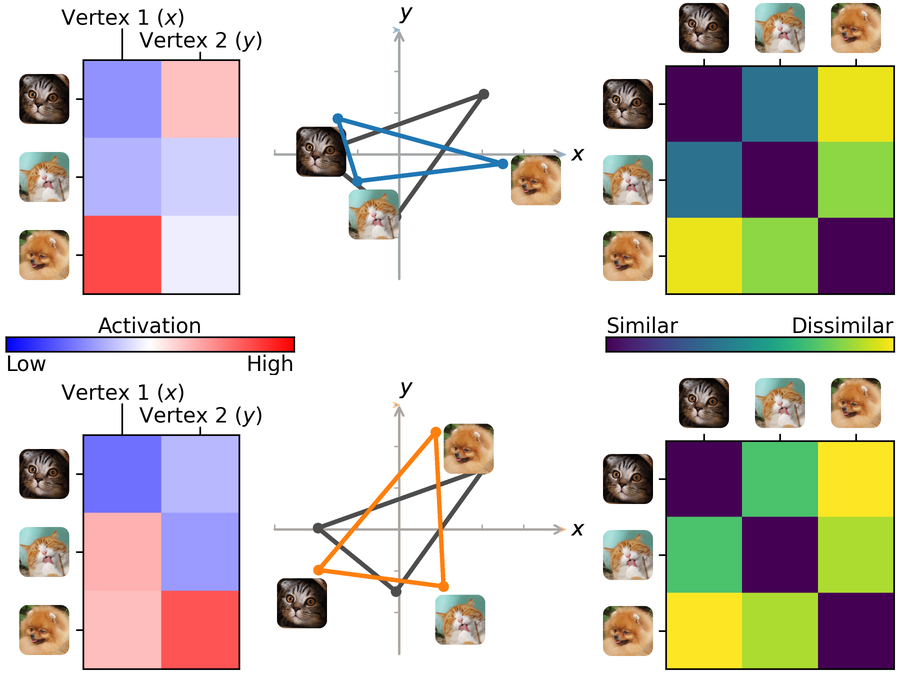
Fig 1. Schematic illustration of Procrustes hyperalignment. With a high-dimensional rotation in the feature space (middle), the response patterns of different individuals (left) are aligned into a common space. The representational geometry (right) is preserved in this process.
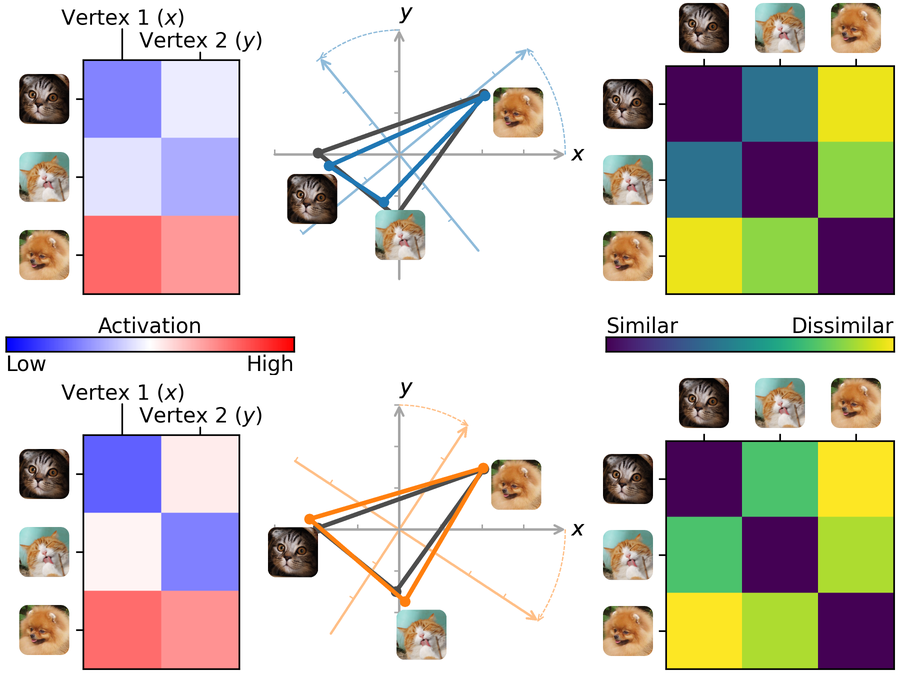
Fig 1. Schematic illustration of Procrustes hyperalignment. With a high-dimensional rotation in the feature space (middle), the response patterns of different individuals (left) are aligned into a common space. The representational geometry (right) is preserved in this process.
Ridge hyperalignment
Ridge hyperalignment Feilong et al., 2023 (sometimes referred to as warp hyperalignment) uses ridge regression to learn the functional correspondence across individuals. In addition to rotations or reflections, ridge hyperalignment allows scaling and shearing in the feature space, enabling more flexible alignment. This approach captures both topographic and representational differences across individuals.

Fig 2. Schematic illustration of ridge hyperalignment. The transformation derived using ridge regression is not limited to orthogonal transformations (rotations and reflections) but can also include scaling and shearing in the feature space. These additional degrees of freedom allow ridge hyperalignment to account for both topographic and representational differences across individuals.
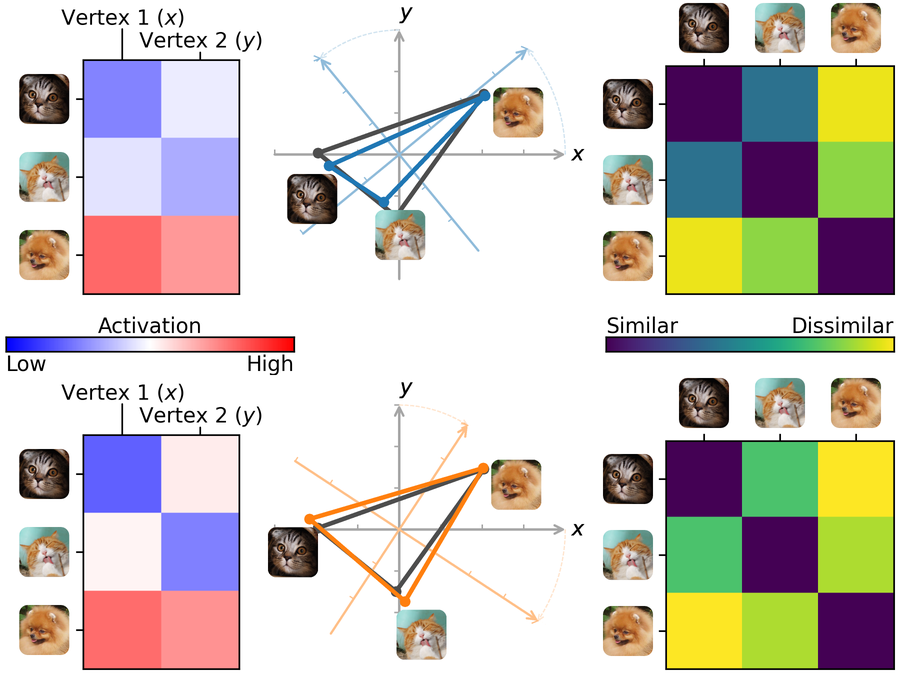
Fig 2. Schematic illustration of ridge hyperalignment. The transformation derived using ridge regression is not limited to orthogonal transformations (rotations and reflections) but can also include scaling and shearing in the feature space. These additional degrees of freedom allow ridge hyperalignment to account for both topographic and representational differences across individuals.
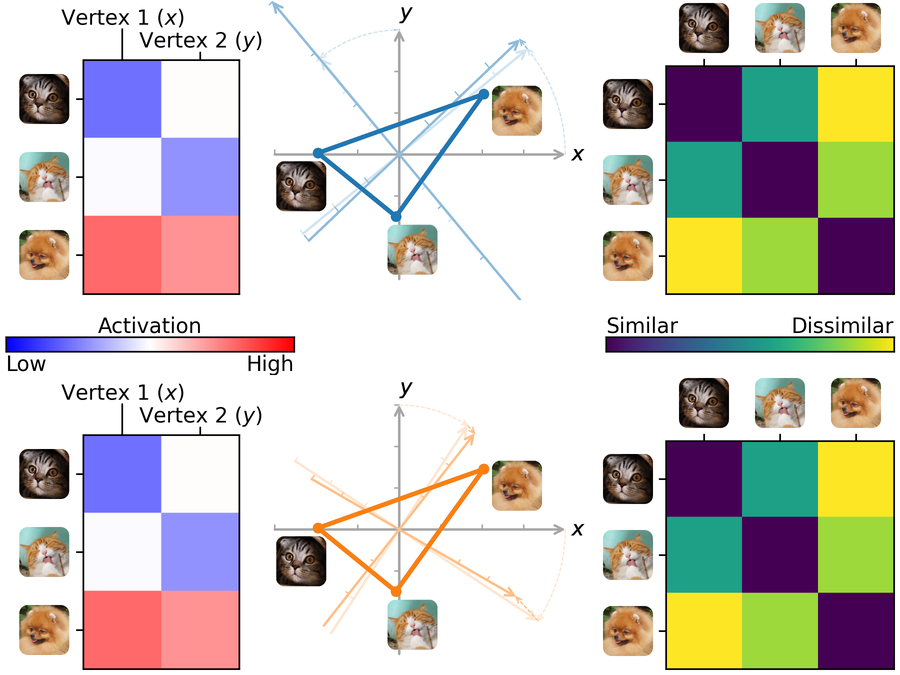
Fig 2. Schematic illustration of ridge hyperalignment. The transformation derived using ridge regression is not limited to orthogonal transformations (rotations and reflections) but can also include scaling and shearing in the feature space. These additional degrees of freedom allow ridge hyperalignment to account for both topographic and representational differences across individuals.
Individualized Neural Tuning (INT) model
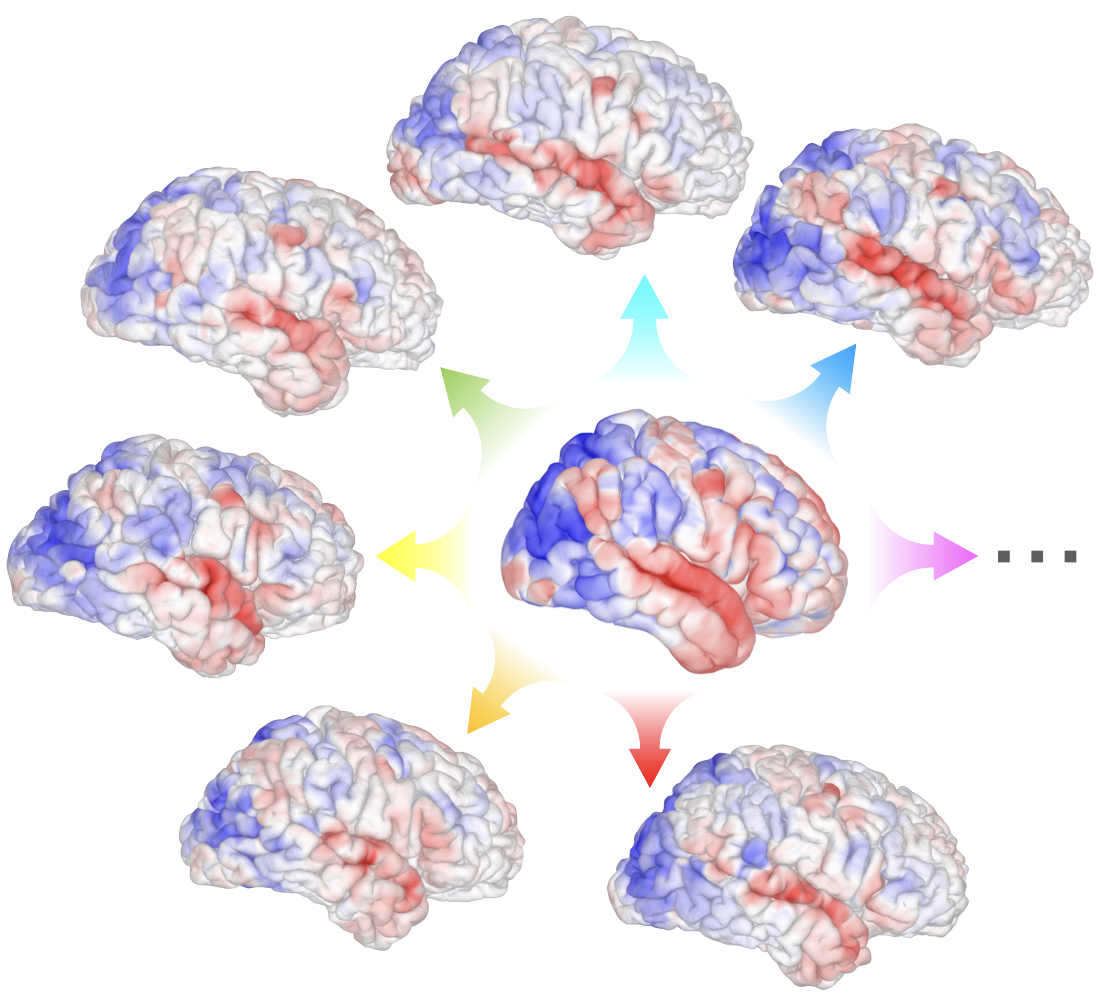
Fig 3. Schematic illustration of the Individualized Neural Tuning (INT) model. In the INT model, the brain responses of each individual are modeled as an individualized transformation of a shared template. See Feilong et al. (2023) for details.
References
- Haxby, J. V., Guntupalli, J. S., Nastase, S. A., & Feilong, M. (2020). Hyperalignment: Modeling shared information encoded in idiosyncratic cortical topographies. Elife, 9, e56601. https://doi.org/10.7554/eLife.56601
- Haxby, J. V., Guntupalli, J. S., Connolly, A. C., Halchenko, Y. O., Conroy, B. R., Gobbini, M. I., Hanke, M., & Ramadge, P. J. (2011). A common, high-dimensional model of the representational space in human ventral temporal cortex. Neuron, 72(2), 404–416. https://doi.org/10.1016/j.neuron.2011.08.026
- Guntupalli, J. S., Hanke, M., Halchenko, Y. O., Connolly, A. C., Ramadge, P. J., & Haxby, J. V. (2016). A model of representational spaces in human cortex. Cerebral Cortex, 26(6), 2919–2934. https://doi.org/10.1093/cercor/bhw068
- Guntupalli, J. S., Feilong, M., & Haxby, J. V. (2018). A computational model of shared fine-scale structure in the human connectome. PLoS Computational Biology, 14(4), e1006120. https://doi.org/10.1371/journal.pcbi.1006120
- Feilong, M., Nastase, S. A., Jiahui, G., Halchenko, Y. O., Gobbini, M. I., & Haxby, J. V. (2023). The individualized neural tuning model: Precise and generalizable cartography of functional architecture in individual brains. Imaging Neuroscience, 1, 1–34. https://doi.org/10.1162/imag_a_00032