Brain differences and their correlates

A key focus of our lab is understanding individual differences in the human brain, including:

Fine-grained brain functional organization
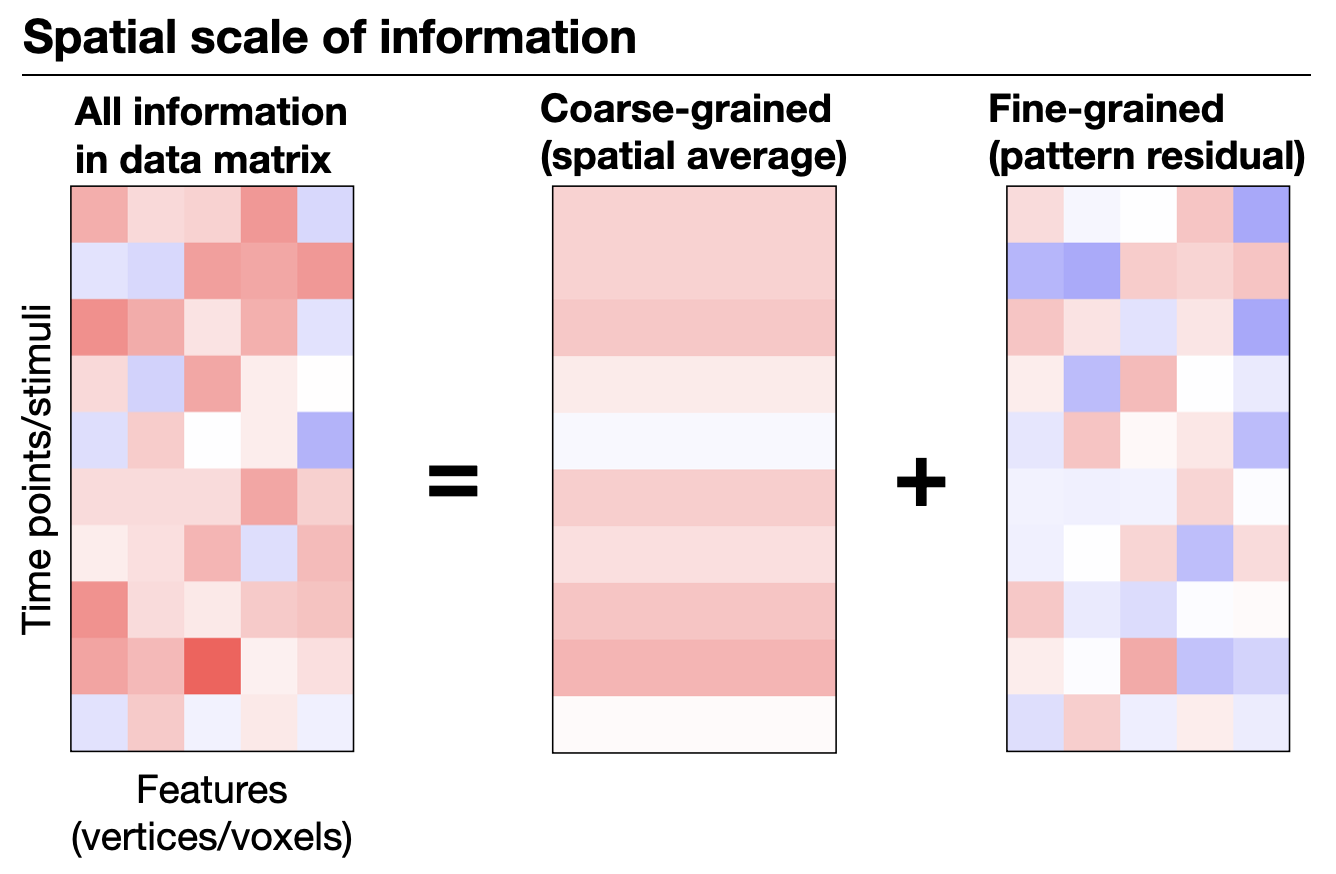
Coarse- versus fine-grained information in fMRI data

Fig 1. Coarse- vs. fine-grained information. Coarse-grained information is derived by spatially smoothing or averaging fMRI data within regions, reflecting their overall activity or connectivity (centimeter scale). Fine-grained information, in contrast, captures detailed vertex-by-vertex or voxel-by-voxel patterns within regions (millimeter scale).

We are particularly interested in individual differences in fine-grained brain functional organization — the detailed spatial patterns of brain activity and connectivity at the voxel or vertex level. Compared to coarse-grained differences (e.g., region-level averages), these fine-grained differences are

  1. more reliable across independent data and more congruent across functional indices (Feilong et al. 2018);
  2. more predictive of intelligence and other cognitive abilities (Feilong et al. 2021);
  3. more experience-driven, potentially reflecting learning and training effects (Busch et al. 2024).
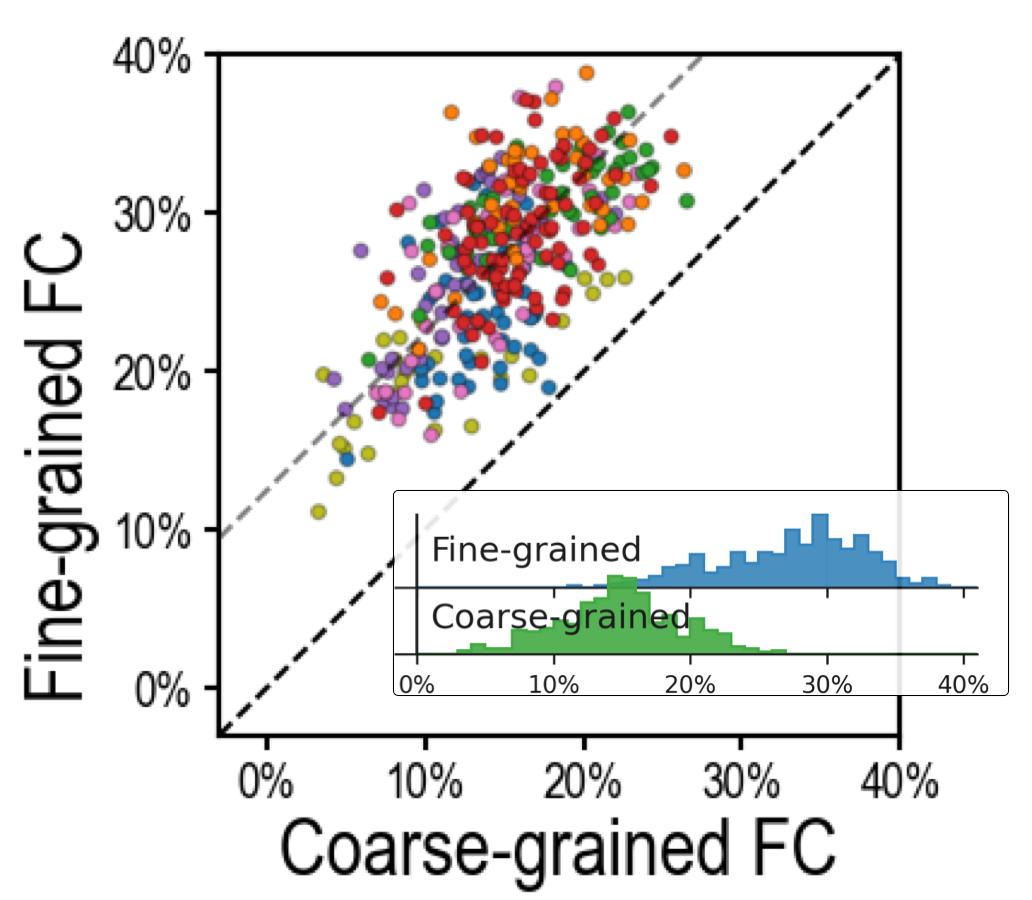
Fine-grained connectivity predicts general intelligence better than coarse-grained connectivity

Fig 2. Predicting general intelligence (g). Fine-grained functional connectivity profiles (y-axis, blue histogram) are markedly better predictors of general intelligence than coarse-grained connectivity profiles (x-axis, green histogram) across different brain systems, accounting for twice as much variance in g. Adapted from Figure 3 in Feilong et al. (2021). Similar effects are observed for both task- and resting-state connectivity, and across different cognitive abilities (Feilong et al. 2021).

These fine-grained differences are often obscured by individual variability in anatomical–functional correspondence and cannot be properly studied using traditional alignment methods. We use hyperalignment (Haxby et al. 2020) and the Individualized Neural Tuning (INT) model (Feilong et al. 2023) to resolve these idiosyncrasies and reveal the individual differences in fine-grained functional organization.

References

Busch, Erica L, Kristina M Rapuano, Kevin M Anderson, et al. 2024. “Dissociation of Reliability, Heritability, and Predictivity in Coarse-and Fine-Scale Functional Connectomes During Development.” Journal of Neuroscience 44 (6). https://doi.org/https://doi.org/10.1523/JNEUROSCI.0735-23.2023.
Feilong, Ma, J Swaroop Guntupalli, and James V Haxby. 2021. “The Neural Basis of Intelligence in Fine-Grained Cortical Topographies.” Elife 10: e64058. https://doi.org/https://doi.org/10.7554/eLife.64058.
Feilong, Ma, Samuel A Nastase, J Swaroop Guntupalli, and James V Haxby. 2018. “Reliable Individual Differences in Fine-Grained Cortical Functional Architecture.” NeuroImage 183: 375–86. https://doi.org/https://doi.org/10.1016/j.neuroimage.2018.08.029.
Feilong, Ma, Samuel A Nastase, Guo Jiahui, Yaroslav O Halchenko, M Ida Gobbini, and James V Haxby. 2023. “The Individualized Neural Tuning Model: Precise and Generalizable Cartography of Functional Architecture in Individual Brains.” Imaging Neuroscience 1: 1–34. https://doi.org/https://doi.org/10.1162/imag_a_00032.
Haxby, James V, J Swaroop Guntupalli, Samuel A Nastase, and Ma Feilong. 2020. “Hyperalignment: Modeling Shared Information Encoded in Idiosyncratic Cortical Topographies.” Elife 9: e56601. https://doi.org/https://doi.org/10.7554/eLife.56601.